7 Key Characteristics of Effective Practice-Based Coaching Partnerships - Brookes Blog
7 Key Characteristics of Effective Practice-Based Coaching Partnerships
December 2, 2021
If you’re an early childhood professional, you know that applying evidence-based practices in your daily work is key to achieving your ultimate goal: positive developmental and learning outcomes for infants, toddlers, and young children. Practice-Based Coaching (PBC) is a proven framework for helping professionals learn and implement these effective practices. Used widely across the U.S. and around the world, PBC is a research-based approach that pairs professionals with coaches in a collaborative partnership; together, they assess the strengths and needs of the coachee and design a plan for implementing effective practices.
The new book Essentials of Practice-Based Coaching, by Patricia Snyder, Mary Louise Hemmeter, & Lise Fox, is the first to offer a comprehensive introduction to this popular coaching approach and practical guidance on how to implement it with fidelity. In today’s blog post, adapted from the book, you’ll get a quick introduction to 7 key characteristics of a successful PBC partnership. Read on to learn what it takes to form a strong coach/coachee partnership, and then explore the book for a complete guide to PBC.
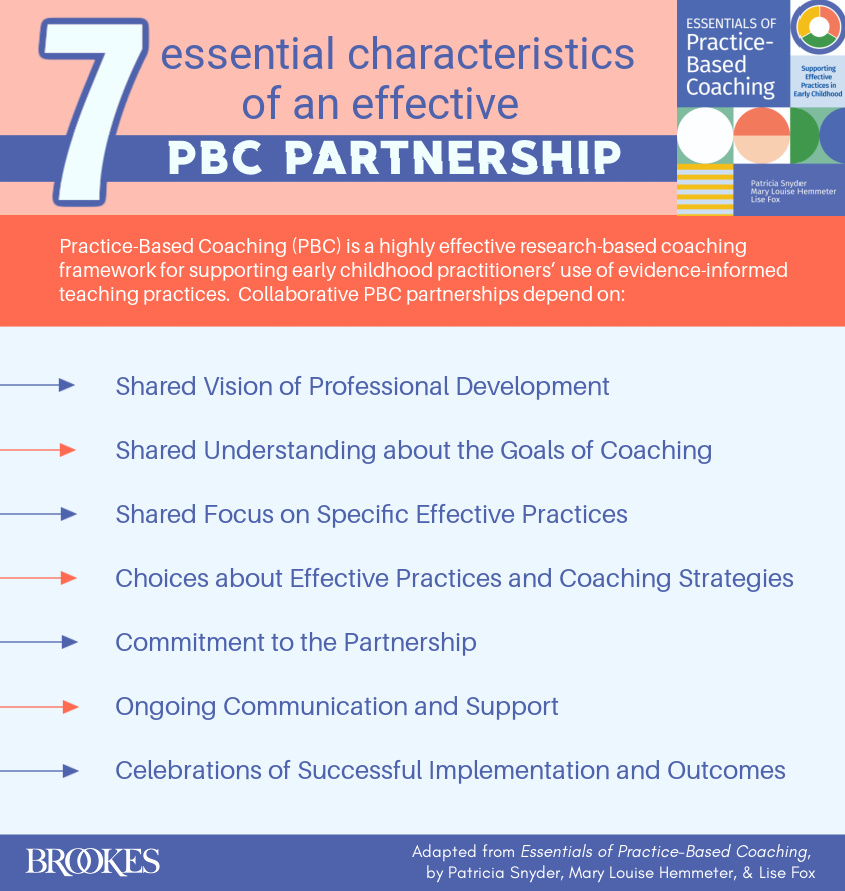
Download the infographic
For a quick snapshot of an effective PBC partnership, click the link below to download this handy infographic.
1. Shared Vision of Professional Development
The first step toward developing a successful coaching partnership is the coach and coachee collaborating on a shared vision of adult learning and professional development—and creating opportunities for the coachee to nurture that vision through their daily work. Typically, the first few meetings of a new partnership involve drawing connections between content or strategies provided by the coach and the coachee’s own practice experiences. Coaches highlight practices that have been proven to support healthy child development, identify which of the coachee’s existing strengths and priorities are suited to implementation of those practices, and then work with the coachee to determine ways they might strengthen their practice.
2. Shared Understanding About the Goals of Coaching
For a PBC partnership to be productive, it’s essential that the coach and coachee also have a shared understanding about the specific goals of coaching. Both members of the coaching partnership should consider the following question: Why is coaching happening in the first place? Answers might include: to work toward implementation of a new curriculum or program, to help reach a program’s school readiness goals, or to aid in IEP implementation for children with or at risk for disabilities.
Members of a coaching team often find it helpful to create a written agreement that details the goals and roles for both the partners. Each agreement will be specific to the needs and priorities of the people involved, but there are common elements that can be found in almost all coaching pacts. Consider details like:
- When and how frequently will coaching sessions occur?
- What is the coach’s role during an observation?
- How will the coach and coachee prepare for goal-setting, observation, reflection, and feedback?
- What information is considered confidential and what might be shared with others?
- What data will be collected as part of the coaching, and why?
If a coach understands how a program’s leadership has framed PBC within their organization, they’ll be better equipped to engage with their coaching partners and skillfully guide the development of evidence-informed teaching practices.
3. Shared Focus on Specific Effective Practices
After coaching partners have established explicit roles and goals within the PBC framework, they can begin to draw up a set of effective practices to support child development and learning. Part of a coach’s job is to help the coachee identify a manageable number of clearly defined, observable strategies that they feel confident enough to implement in a practice context.
Concentrating on a limited number of practices in each coaching cycle is helpful for several reasons:
- It allows coaches to avoid general assessments of practice quality, which might feel overwhelming to a coachee.
- It helps coaching partners steer clear of potential “gotcha” moments in which a coachee might feel defensive about a coach’s feedback.
- It builds coachee confidence and independence.
- It encourages a spirit of experimentation and curiosity rather than a self-conscious feeling that they have to be “perfect” or know everything.
4. Choices about Effective Practices and Coaching Strategies
Throughout the PBC process, collaborative partners share decision-making related not only to content (effective practices being learned by the coachee), but also structures (how the coachee will receive the coaching) and processes (supportive coaching interactions).
Successful PBC partners ask and answer critical questions that will guide and shape the coaching experience, including:
- When and how will the coachee be observed in the practice setting?
- Will the coach model or demonstrate practices?
- What data would be useful to the coachee?
- Will the entire team be coached or just the lead teacher?
When partners work together from the beginning to make decisions about which types of interactions and strategies they each prefer, the coaching partnership is more likely to be productive and successful.
5. Commitment to the Partnership
In any coaching partnership, follow-through is key: each partner must commit to agreed-upon goals, action plans, and coaching structures and processes. The partners should:
- Refer to and uphold the coaching agreement.
- Ensure that all meetings start and end on time.
- Respect each other’s schedules.
- Communicate changes in advance using preferred methods (e.g., text, email, message left at front desk).
- Honor confidentiality by not sharing details of coaching conversations with others.
- Stay sensitive to one another’s strengths and needs throughout the process.
6. Ongoing Communication and Support
Clear and consistent communication is important in any successful partnership. To build trust and demonstrate respect, coaches should provide ongoing communication and support to their coachee, through actions like:
- Calling ahead if running late.
- Rescheduling a meeting when a practitioner is in the midst of an emergency.
- Sending an email with notes summarizing a coaching conversation.
- Texting their coachee after a celebration or difficult day.
- Dropping a handwritten note in the school mailbox to recognize an accomplishment.
Collaborative partners should also recognize the fact that adults have complex lives, and that family, health, financial, and job stressors affect both coaches and coachees.
7. Celebrations of Successful Implementation and Outcomes
Good coaches acknowledge that effective practice is hard and much of the work is invisible to others. They recognize the nuanced decision-making and individualization required of coachees on a daily basis. Trust is built as coaches celebrate small successes: a child who followed a direction, played with a peer, or joined an activity because of the coachee’s actions. Such celebrations are strong motivators for future practice implementation.
Practice-Based Coaching is one of the most effective and evidence-supported professional development approaches for early childhood practitioners. To learn much more about how collaborative coaching partnerships can transform your program, explore the book Essentials of Practice-Based Coaching, an essential guide created by the PBC developers to help every practitioner master today’s recommended practices.
Essentials of Practice-Based Coaching
Ideal for use in professional development, this research-to-practice resource gives readers an in-depth overview of the Practice-Based Coaching framework and a complete guide to implementing its three key components: shared goals and action planning, focused observation, and reflection and feedback.